

How to Prepare for CAT Exam 2026 — Complete Strategy Guide with Mock Test Tips
CAT 2026 will be held in November 2026. That gives you approximately 8 months from today to build the skills, speed, and exam temperament needed to score in the 99th percentile. This guide gives you the complete preparation strategy used by Headache Tutorials faculty — the same approach that has produced AIR 1 results in JIPMAT and 100 percentile scores in CUET among our students.
Understanding the CAT 2026 Exam Pattern
CAT is a 2-hour computer-based test with three sections: Verbal Ability and Reading Comprehension (VARC) with 24 questions, Data Interpretation and Logical Reasoning (DILR) with 20 questions, and Quantitative Aptitude (QA) with 22 questions — totalling 66 questions. Marking is +3 for correct MCQ answers, -1 for wrong MCQs, and 0 for TITA (type in the answer) questions. You get 40 minutes per section with no switching allowed between sections.
Phase 1 (March–June): Build Your Foundation
The first 4 months of CAT preparation should focus entirely on concept-building — not speed, not mock tests. Students who skip this phase and jump straight to mock tests end up plateauing at 80–85 percentile because they are making the same conceptual errors repeatedly under timed conditions.
For VARC: Read one editorial or long-form article daily — The Hindu, Business Standard, or Aeon Essays. Build the habit of reading at 250+ words per minute with comprehension. Work through RC passage analysis systematically: identify the main argument, paragraph function, and tone before attempting questions.
For QA: Cover all topics from scratch — Arithmetic (Percentages, Ratio, TSD, Work), Algebra (Equations, Inequalities, Functions), Geometry (Triangles, Circles, Mensuration), Number Theory, and Modern Maths (P&C, Probability, Sets). Give 2–3 days per topic minimum. Do not move on until you can solve 80% of standard questions from that topic.
For DILR: Practice 2 sets daily. DILR is the section that surprises most students because it cannot be mugged up — it requires pattern recognition that only comes from volume. Work through Arrangements, Tables, Graphs, Games & Tournaments, and Network diagrams.
Phase 2 (July–September): Mock Tests — The Core of CAT Preparation
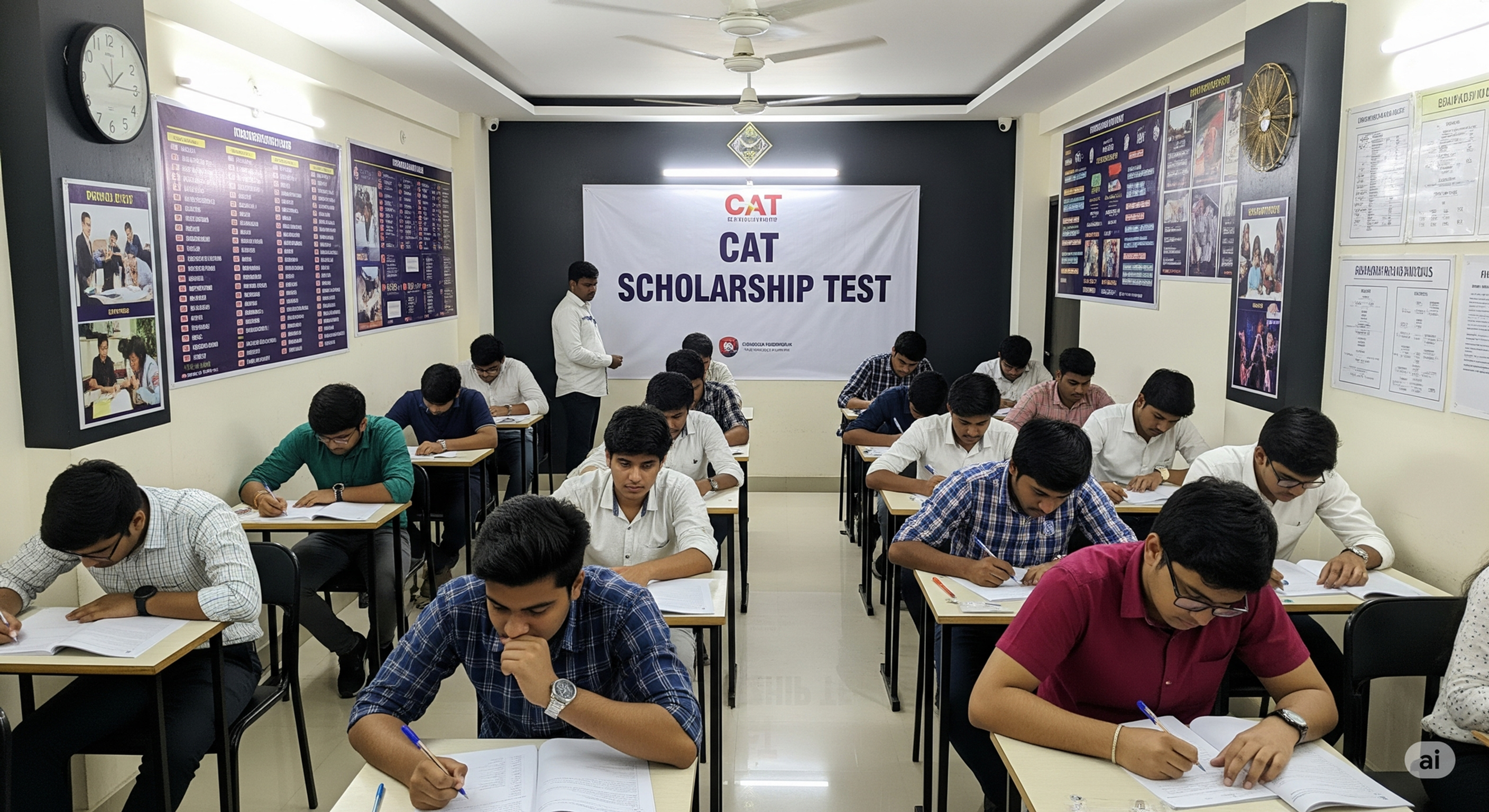
Mock tests are not optional for CAT — they are the single most important activity in your entire preparation. A student who has done 40 full-length mocks with thorough analysis will consistently outperform a student who has covered more theory but done fewer mocks. Here is why mock tests are so effective for MBA entrance exams:
They simulate real exam pressure — time, interface, and fatigue — which cannot be replicated by sectional practice
They reveal your actual selection strategy — which questions to attempt, which to skip — something theory cannot teach
They expose your recurring mistakes — errors you do not notice in practice because there is no time pressure
They build percentile awareness — you learn what score in each section translates to what percentile
The key rule: spend more time analysing each mock than you spent taking it. A 2-hour mock should have a 3–4 hour analysis. Go through every question you got wrong, every question you skipped that was solvable, and every question where you guessed correctly by luck. This analysis session is where the real learning happens.
Target: 2 full-length mocks per week from July. By October, increase to 3 per week. Total target: 40–50 full-length mocks before CAT day.
Phase 3 (October–November): Consolidation and Exam Strategy
By October, your preparation phase is over. Do not start new topics. This phase is about sharpening what you know, locking in your section-wise strategy, and maintaining mental readiness. Revise your error log — a document where you have recorded every recurring mistake across your mocks. Attempt 2 mocks per week. In the final week before CAT, take one mock 3 days before the exam, then stop.
Section-Wise Tips from Headache Tutorials Faculty
VARC: Never attempt all 5 passages. Pick 3–4 based on difficulty and familiarity of topic. In Verbal Ability, TITA questions (Para Jumbles, Summary) are high-accuracy opportunities — do not skip them.
DILR: Spend the first 5 minutes scanning all 5 sets. Rank them by solvability. Attempt your two easiest sets first, fully. A complete set of 4–5 questions solved correctly is worth far more than partial attempts across 3 sets.
QA: Know your strengths. If Geometry is your weakness, skip Geometry questions and pick up Arithmetic instead. Accuracy in 14–16 QA questions will get you to 90 percentile — you do not need to attempt all 22.
How Headache Tutorials Structures CAT Coaching in Indore
At Headache Tutorials, Janjeerwala Square, Indore, our CAT programme follows this exact three-phase structure. Classes are held in small batches of under 15 students, ensuring each student's preparation is tracked individually. Mock tests are administered at regular intervals and followed by mandatory individual analysis sessions with faculty — not just a score sheet handed out.
Both offline coaching at our Indore centre and live online classes are available, so students from across Madhya Pradesh and India can follow this structured programme without relocating. Visit headachetutorials.com to enrol or book a free counselling session.
Frequently Asked Questions — CAT 2026 Preparation
What are the best tips to prepare for the CAT exam?
The most important tips for CAT preparation are: build concept foundations before mocks (Phase 1), take 40+ full-length mocks with thorough analysis (Phase 2), develop a personalised question selection strategy for each section, and maintain an error log across all mocks. Join a structured programme with individual mentoring for best results.
How effective are mock tests for MBA entrance exams?
Mock tests are the single most effective activity for MBA entrance exam preparation. They simulate real exam conditions, reveal question selection strategy, expose recurring errors, and build percentile awareness. A student who takes 40+ mocks with proper analysis will consistently outperform a student with more theory but fewer mocks.
Are there mock tests available for MBA entrance exams in Indore?
Yes. Headache Tutorials at Janjeerwala Square, Indore offers a structured mock test programme for CAT, IPMAT, CMAT, and CUET with individual analysis sessions after each mock. Both enrolled students and external students can access the test series.
How many months does it take to prepare for CAT?
A serious CAT preparation requires 6–8 months. The ideal split is 3–4 months of concept building followed by 3–4 months of intensive mock tests and analysis. Starting in March for a November exam is the ideal timeline.

Comments