

IPMAT Dropper 2027 — Is Dropping a Year Actually Worth It? Score Data & Reality Check
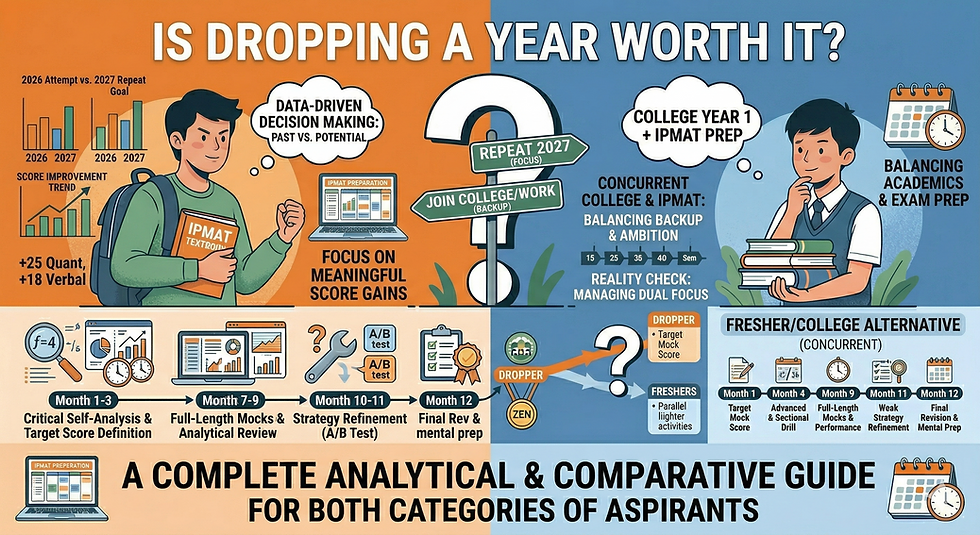
The Real Question Behind 'Is Dropping Worth It?'
Every student considering a gap year for IPMAT 2027 is really asking three things: Can I realistically improve enough to get selected? What do I lose by taking a gap year? And what happens if I drop and still do not make it? This guide answers all three honestly — no false optimism, no unnecessary fear. Just a clear look at what a gap year actually means for IPMAT aspirants.
What Score Improvement Is Realistically Possible in One Structured Year?
These ranges apply to students who structurally change their preparation — new approach, not just more hours. Students who simply add hours without a changed method typically improve by only 10–20 marks, which rarely changes selection outcomes.
What You Give Up by Dropping a Year — Honest Assessment
Dropping means delaying your degree by 12 months, entering the job market one year later, and spending a year outside the natural peer-group progression. There is also psychological weight — explaining the gap year in future interviews, managing family expectations, and dealing with the uncertainty that comes with a second attempt. These are real costs. Acknowledge them before deciding.
What You Actually Gain — Why the Investment Can Be Worth It
A gap year gives you something no Class 12 student has: complete, undistracted focus on a single goal. No board exams, no school pressure, no competing priorities. The IPM programme at IIM Indore or Rohtak opens doors that most BBA programmes cannot. If this is genuinely your goal, a structured gap year is the highest-leverage 12 months available to you at this point in life — but only if you actually use it differently.
IPMAT 2027 Cut-off Reality Check
Do Droppers Actually Perform Better Than Fresh Attempts?
Coaching centre data is consistent: well-prepared droppers outperform first-time unprepared students. The determining variable is not dropper status — it is whether the gap year was used with a structured, changed plan. Droppers who repeat the same approach rarely improve significantly. Droppers who diagnose their specific weak areas and address them with a new strategy frequently crack the exam on the second attempt.
The Best Alternatives If You Decide Not to Drop
Not dropping is a perfectly valid choice. Your realistic paths: (1) Appear for IPMAT 2027 as a Class 12 student if still eligible; (2) Join a strong graduation programme now and target CAT/MBA after 3 years — the IIM brand is fully accessible through that route; (3) Target NMIMS BBA, Christ University BBA, or similar strong management entrances. None of these are consolation paths. The IPM route is one path to an IIM, not the only one.
The 3-Question Decision Framework
Answer these three questions honestly: (1) Did you miss the cut-off by more than 25–30 marks, or did you not prepare at all? (2) Do you have a specific, changed plan for what you will do differently — not just 'study more'? (3) Do you have family support and financial stability for a full year of focused preparation? If all three are yes, dropping is a strong call. If any answer is no, reconsider — a purposeless gap year is worse than moving forward.
What Headache Tutorials Coaches Recommend
Headache Tutorials has produced AIR 1 in JIPMAT (Tanisq Chouhan) and 12 IIM calls in CAT 2025 (Jayant Prajapat). The coaching's guidance on dropper decisions is consistent: a gap year only produces results if accompanied by a specific, changed plan. Extra effort on the same approach rarely changes outcomes. If you are committed to doing things differently, a structured dropper programme gives you the fastest and most reliable path to selection. Visit headachetutorials.com for the IPMAT dropper track.
Frequently Asked Questions
What percentage of IPMAT selections are droppers?
Exact public data is not available, but coaching centre trends suggest a significant portion of selected students at IIM Indore and Rohtak are second-attempt students who prepared structurally.
If I drop and don't get selected in 2027, what happens?
You will have strong preparation, an understanding of competitive exams, and valuable self-discipline built over the year. You can then target a strong graduation programme and pursue CAT for IIM MBA — which many top students do anyway.
How long should a structured IPMAT dropper preparation be?
6 months of serious preparation is the minimum for significant score improvement. 8–10 months gives you time for multiple mock cycles and thorough weak area correction.
Is IIM Rohtak's IPM programme worth dropping for?
IIM Rohtak's IPM is a credible IIM programme with a lower cut-off than Indore. If you are targeting IPM specifically, Rohtak is a strong target alongside Indore.
What is the IPMAT age limit for droppers?
For IPMAT IIM Indore, candidates must be born on or after May 1, 2004 (for 2027 exam — exact date subject to official notification). Always verify the official eligibility criteria when the notification is released.
Can I improve QA from 40% accuracy to 75% in one year?
Yes — returning to conceptual basics and doing daily timed drills on weak topics typically produces significant QA accuracy improvement within 3 months of structured practice.
Should I study 8–10 hours daily during my dropper year?
5–6 focused hours daily is more effective than 8–10 unfocused hours. Quality of study time matters far more than raw hours. Include daily breaks and weekly off-days to sustain performance over the full year.
Does a gap year affect college admissions adversely?
For IIM IPM admissions, a gap year is not penalised as long as you meet the age and qualification criteria. It is a normal part of preparation pathways for competitive exams.
What is the best use of the first month of a dropper year?
Spend the first month entirely on diagnosis and foundation — not on solving new questions. Understand exactly what failed and re-learn the concepts behind your weakest topics from scratch.


Comments